


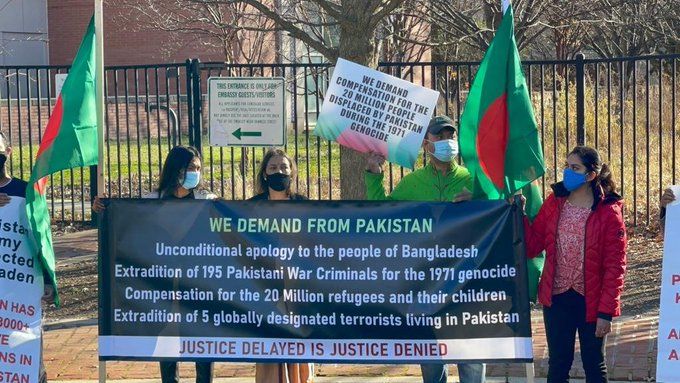
US-based Bangladeshi organisation along with other South Asian minorities held a protest outside the Pakistani Embassy in Washington DC demanding an apology for the 1971 genocide named 'Operation Searchlight'. pic.twitter.com/Tt54Y9qCKx
— ANI (@ANI) December 14, 2020
Two days before the ‘Bijoy Diwas,’ a Bangladeshi group based in the United States organised a rally outside the Pakistani embassy in Washington demanding an apology for human rights abuses committed by the government in 1971. The demonstration featured Bangladeshi nationals and other South Asian minorities.
“The Pakistan! Avoid sheltering 175 war criminals,” read the sign. “Time for Pakistan to apologise for the genocide of 1971,” read another placard. The demonstrators called for a ‘unconditional apology’
The development comes just 2 days ahead of the 39th anniversary of Pakistan’s humiliating defeat to India and the ‘Mukti Bahini’ in the Bangladesh Liberation War of 1971.As such, the 16th of December is observed as Bijoy Diwas in Bangladesh and Vijay Diwas in India in honour of those who have put their lives in the line of service.
The storey started in the 1970s. In the general elections held on 7 December of that year, Sheik Mujibur Rahman of the Awami League won a vast majority (167 seats) in the provincial legislature in East Pakistan. With relentless intervention by his Islamic counterpart in East Pakistan’s affairs, Rahman started to call for greater regional autonomy.
This was only within 13 years of the division of the Indian subcontinent, when Muslims were finding their own independent country. While unified by the shared faith, the hostility of the West and East Pakistan against each other continued to rise. Zulfikar Ali Bhutto of the Pakistan People’s Party (PPP), which won the most seats in West Pakistan in the 1970 elections, rejected Rahman’s demands. He threatened to boycott the Legislature and demanded the abolition of the province. Miffed over the denial of power and autonomy to East Pakistan, Sheikh Mujibur Rahman called civil disobedience movement, on March 7, 1971. Bhutto feared civil war and President Yahya Khan, therefore, declared martial law and ordered the arrest of Rahman and other leaders.
In order to contain the civil and political unrest, the Pakistan army launched Operation Searchlight on March 26, 1971. Rahman, disillusioned by the high-handedness of West Pakistan, had already called for independence from West Pakistan.
The Pakistani soldiers launched their attack on the Bengali population in Rajararbagh and Peelkhana area. They put Mujibur Rahman behind bars and ambushed the Dhaka university, resulting in the death of 9 teachers and 200 students in Iqbal Hal. Similarly, the Pakistan army continued with its barbaric attacks on civilians in Old Dhaka, Tejgaon, Indira Road, Mirpur, Kalabagan and other places.
On the same night, several people in Chittagong were shot dead by the army personnel. National newspapers, including, Daily Ittefaq, the Daily Sangbad were shut down and their offices were set ablaze, resulting in the death of several media personnel. Mass graves were dug out and hastily bulldozed. An estimated 700 people were burnt to death in Dhaka. Similarly, they set fire to the houses of slum dwellers, fired bullets at those running away to save their
It is believed that around 10,000-35,000 Bengalis were killed by the Pakistan army under the Operation Searchlight while the death toll to increased to over 3 lacs in the months to follow.
“Thanks to God that Pakistan could have been saved,” Bhutto had famously remarked. The genocide against the Bengali population intensified. In the months to follow, around 4 lac Bengali women were raped by the Pakistan army while a majority of the victims being Hindus.
The situation worsened, forcing neighbouring India to step in to prevent the further continuation of genocide. In 14 days, Pakistani forces under AK Niazi signed the Instrument of surrender and thus a new nation of Bangladesh was born. While Bangaldesh has tried and hanged several war criminals, Pakistan continues to dispute the 1971 genocide, far from being apologetic about the heinous crimes.
Recently, Bangladesh Prime Minister Sheikh Hasina confronted Pakistan over the atrocities it unleashed against Bangladesh during the 1971 war. Hasina said that human rights violations Pakistani forces unleashed during the war of independence in 1971 are “unshakeable memories” for Bangladesh.
Her strong remarks against Pakistan came during her meeting with Imran Ahmed Siddiqui, the Pakistani high commissioner in Dhaka. “Incidents of 1971 cannot be forgotten. The pain will remain forever,” she said as she met Pakistan High Commissioner Imran Ahmed Siddiqui in Dhaka on Friday. Citing to the volumes of the book titled “Secret Documents of Intelligence Branch on Father of the Nation Bangabandhu Sheikh Mujibur Rahman”, Prime Minister Sheikh Hasina said all can learn many historical facts from 1948 to 1971 from the books.